What is AI? Learn everything about Artificial Intelligence—its meaning, history, types, working, applications, advantages, challenges, and future in this complete guide.
What is AI? A Comprehensive Guide to Artificial Intelligence
Introduction
Artificial Intelligence (AI) is one of the most revolutionary technologies shaping the modern world. From smartphones and self-driving cars to virtual assistants and healthcare innovations, AI has become a part of everyday life. But what exactly is AI, how does it work, and why is it so important? In this article, we will explore AI in detail—its meaning, history, types, applications, advantages, challenges, and future possibilities.
Meaning of AI
AI, or Artificial Intelligence, refers to the ability of machines to simulate human-like intelligence. In simple terms, it means designing computer systems that can perform tasks that normally require human thinking. These tasks include problem-solving, learning, reasoning, understanding language, recognizing images, and making decisions.
The word “artificial” means something created by humans, while “intelligence” refers to the ability to think, learn, and adapt. Put together, Artificial Intelligence is the intelligence demonstrated by machines rather than natural human intelligence.
A Brief History of AI
The concept of AI is not new. Ancient myths and stories often spoke of mechanical beings brought to life. However, the scientific foundation of AI began in the 20th century.
- 1950: British mathematician Alan Turing proposed the famous Turing Test, which asked whether a machine could think like a human.
- 1956: The term Artificial Intelligence was officially introduced at the Dartmouth Conference, marking the birth of AI as a field of study.
- 1970s-1980s: AI research faced challenges known as “AI winters” due to limited computing power.
- 1997: IBM’s computer Deep Blue defeated world chess champion Garry Kasparov.
- 2010 onwards: Rapid growth in AI due to machine learning, big data, and advanced computing.
Today, AI is powering digital assistants like Siri and Alexa, autonomous vehicles, medical research, and even creative industries.
Types of AI
AI can be divided into different types based on capability and functionality.
Based on Capability:
- Narrow AI (Weak AI) – Designed for a specific task, such as Google search or face recognition.
- General AI (Strong AI) – Machines with the ability to perform any intellectual task like a human (still theoretical).
- Superintelligent AI – A futuristic concept where AI surpasses human intelligence.
Based on Functionality:
- Reactive Machines – Simple AI that reacts to situations (e.g., chess-playing programs).
- Limited Memory – Can learn from past data (e.g., self-driving cars).
- Theory of Mind – Future AI that may understand emotions and human behavior.
- Self-aware AI – Hypothetical AI with consciousness.
How Does AI Work?
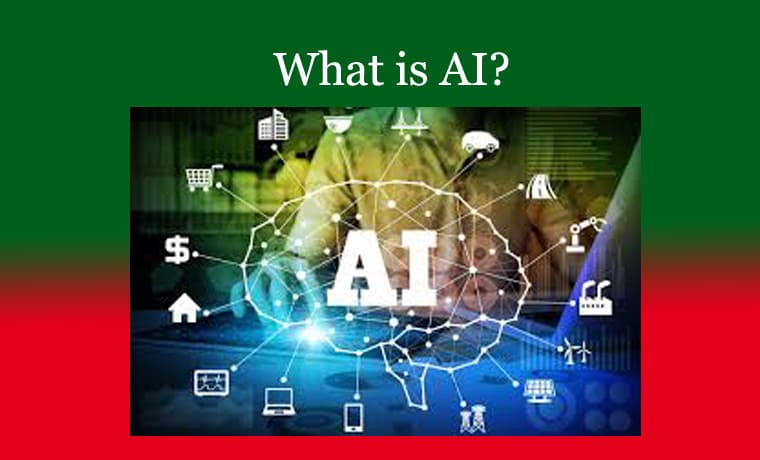
AI works through a combination of technologies like machine learning, deep learning, natural language processing (NLP), and neural networks.
- Machine Learning (ML): AI learns from data and improves over time without explicit programming.
- Deep Learning: A subset of ML that uses neural networks, similar to the human brain, for advanced problem-solving.
- Natural Language Processing (NLP): Helps machines understand and communicate in human language.
- Computer Vision: Enables AI to see and recognize objects in images or videos.
For example, when you use Google Maps, AI analyzes traffic patterns, predicts the best route, and gives you real-time updates.
Applications of AI
AI has countless applications in almost every sector:
- Healthcare: AI helps in diagnosing diseases, drug discovery, and personalized treatment.
- Education: Smart learning platforms, AI tutors, and personalized study recommendations.
- Business: Chatbots, fraud detection, and data-driven decision-making.
- Transportation: Self-driving cars, traffic management, and logistics optimization.
- Entertainment: Netflix recommendations, AI-generated art, and music.
- Finance: Stock market predictions, risk analysis, and digital banking.
- Agriculture: Crop monitoring, smart irrigation, and yield prediction.
Advantages of AI
- Efficiency: AI performs tasks faster and with higher accuracy.
- Automation: Replaces repetitive human labor, saving time and costs.
- Data Analysis: Processes massive amounts of data for better decision-making.
- Healthcare Benefits: Early diagnosis and treatment improvement.
- Availability: AI systems work 24/7 without breaks.
Challenges of AI
Despite its benefits, AI also poses challenges:
- Job Displacement: Automation may replace human workers.
- Ethical Concerns: AI decision-making raises questions about fairness and bias.
- Security Risks: AI can be misused in cyberattacks.
- High Cost: Development and maintenance of AI systems are expensive.
- Dependence on Data: AI requires vast and high-quality data to function.
Future of AI
The future of AI holds great promise. Experts predict breakthroughs in medical research, climate change solutions, and smarter cities. At the same time, regulations and ethical frameworks will be essential to ensure AI benefits humanity. The rise of explainable AI (making AI decisions transparent) and responsible AI will shape the future.
You May Like: What is My IP Address?
Frequently Asked Questions on What is AI?
1. What does AI stand for?
AI stands for Artificial Intelligence.
2. Who is the father of AI?
John McCarthy is widely regarded as the father of AI.
3. Is AI dangerous?
AI itself is not dangerous, but misuse or lack of regulations can cause risks.
4. Where is AI used today?
AI is used in healthcare, education, business, entertainment, finance, transportation, and more.
Q5. What is the future of AI?
AI will become more advanced, helping in medical research, smart cities, and global problem-solving, while also requiring careful ethical considerations.
6. What is AI in simple words?
AI is the ability of machines to mimic human intelligence, such as learning, reasoning, and problem-solving.
7. What is AI and how does it work?
AI works by using data, algorithms, and computer models to simulate human intelligence and perform specific tasks.
8. What is AI used for in daily life?
AI is used in voice assistants, online shopping recommendations, GPS navigation, chatbots, and healthcare tools.
9. What is AI in technology?
In technology, AI refers to smart systems that can process data, recognize patterns, and make decisions like humans.
10. What is AI and why is it important?
AI is important because it improves efficiency, automates tasks, and helps solve complex global problems.
11. What is AI in education?
AI in education includes personalized learning platforms, AI tutors, grading systems, and smart study apps.
12. What is AI in business?
Businesses use AI for customer support, fraud detection, data analysis, and better decision-making.
13. What is AI in healthcare?
AI helps in early diagnosis, drug discovery, patient monitoring, and robotic surgeries.
14. What is AI in banking and finance?
In banking, AI is used for risk assessment, detecting fraud, managing investments, and virtual assistants.
15. What is AI and machine learning?
AI is the broader concept of machines being intelligent, while machine learning is a subset that allows machines to learn from data.
16. What is AI and its types?
he main types of AI are Narrow AI, General AI, and Superintelligent AI. Functionally, it includes reactive machines, limited memory, theory of mind, and self-aware AI.
17. What is AI in robotics?
Artificial Intelligence in robotics allows robots to perform tasks autonomously, recognize environments, and interact with humans.
18. What is AI in gaming?
AI in gaming creates realistic opponents, enhances player experience, and adapts game difficulty.
19. What is AI and its advantages?
The advantages of AI include automation, faster decision-making, data analysis, and continuous availability.
20. What is AI and its future scope?
The future of AI encompasses smarter healthcare, self-driving cars, advanced automation, and addressing global challenges such as climate change.
Conclusion
Artificial Intelligence is no longer just science fiction—it is a living reality transforming industries, lifestyles, and economies. By understanding what AI is, how it works, and where it is headed, we can use it responsibly to improve our world. While challenges exist, AI’s potential to bring innovation, efficiency, and problem-solving is limitless.