Explore Song of the Hindustanee Minstrel by H. Derozio, analyzing its themes of India’s glorious past, colonial struggles, and hope for revival. This critical appreciation delves into the poem’s imagery, tone, and relevance to the modern quest for national pride and cultural resurgence.
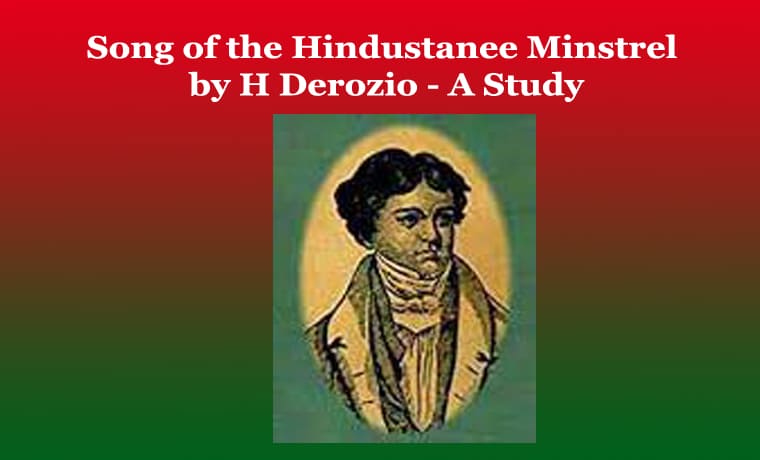
Song of the Hindustanee Minstrel by H Derozio – A Study
Henry Derozio’s “Song of the Hindustanee Minstrel” undergoes a profound analysis, delving into its celebration of India’s vibrant and diverse cultural mosaic while concurrently spotlighting the challenges faced by the minstrel, symbolizing the marginalized and voiceless members of society. The poem serves as a poignant commentary on the socio-cultural dynamics of Derozio’s era, echoing themes that retain relevance in contemporary times.
The minstrel, as portrayed in the poem, emerges as a resilient and creative figure, embodying India’s cultural richness through his musical expressions. Derozio eloquently captures the kaleidoscope of Indian culture, illustrating the unity in diversity that characterizes the nation. The minstrel, wielding his songs, becomes a representative voice, traversing the expanse of the land, uniting various regions through music and lyrical storytelling.
Nevertheless, the poem also illuminates the harsh reality confronting the minstrel. Despite being a custodian of culture and tradition, he exists on the peripheries of society, grappling for recognition and acceptance. Derozio paints a poignant picture of the minstrel’s social standing, depicting a lack of appreciation for his artistry and the challenges he encounters as a perpetual outsider, wandering from place to place.
Moreover, the poem ‘The Song of the Hindustani Minstrel’ can be interpreted as a commentary on society’s neglect of artists and their pivotal role in shaping the cultural fabric. It draws attention to the disregard for those who preserve the heritage and ethos of the nation. Derozio underscores the irony of a society that treasures its cultural wealth yet overlooks the individuals embodying and propagating that very culture.
The poem ‘The Song of the Hindustani Minstrel’ reverberates with themes of social inequality, the valorization of art and culture, and the struggles of the marginalized within a society often indifferent to their contributions. It stands as a compelling tribute to the richness of Indian culture and a lament for the apathy displayed toward its custodians.
Through this poem ‘Song of the Hindustanee Minstrel‘ Derozio not only exalts the beauty and diversity of India but also presents a societal critique, urging recognition and appreciation for the unacknowledged heroes preserving the essence of the nation’s cultural identity. 0 0 0.
Song of the Hindustanee Minstrel: Text
I
I am a Hindustanee minstrel, and I come
With my guitar in hand, and a song on my lips;
I am the poet of the nation, and I sing
To the children of the land where the lotus blooms.
The morning breeze blows sweet, and the evening air
Is filled with the perfume of the jasmine flowers;
The moonlight is soft, and the stars are bright,
And my heart is full of the love of my land.
II
I have sung of the glories of the past,
Of the heroes of old, and their deeds of valor,
Of the battles they fought, and the victories they won,
And the glory they earned for their country and king.
But now I sing of the sorrows of the present,
Of the woes that afflict the people of my land,
Of the poverty, the pain, and the oppression,
That weigh down upon us like a heavy chain.
III
But still, my heart is full of hope and courage,
For I know that the dawn will break, and the sun will shine,
And the people of my land will rise again,
And we will throw off the chains that bind us.
We will rebuild our temples, and our palaces,
And we will restore our ancient glory.
We will be a free and powerful nation again,
And my song will be a song of joy and triumph. 0 0 0
Critical Appreciation of ‘Songs of the Hindustani Minstrel’ by H. Derozio
Henry Louis Vivian Derozio, an eminent poet of the Bengal Renaissance, is known for his passionate expressions of nationalist pride, social reform and the pursuit of knowledge. ‘Songs of the Hindustani Minstrel’ embodies these ideals, offering a unique perspective on India’s cultural heritage, past glories, present challenges and hope for a better future. Through this poem, Derozio reflects on India’s historical grandeur and its struggles under British colonial rule and urges a revival of the nation’s spirit and strength.
Theme and Content
The central theme of ‘Songs of the Hindustani Minstrel’ revolves around the tension between India’s glorious past and troubled present. The poet, adopting the persona of a Hindustani minstrel, speaks as the voice of the nation – proud of its ancient civilization and mournful of its present oppression. The poem varies between memories of India’s rich history and sadness at its contemporary condition under foreign rule.
Glorious Past: The singer sings about India’s ancient glory, making references to the heroes and wars of the past. These references instill a sense of pride in India’s historical achievements, such as its strong empire, philosophical and cultural advancement.
Troubled Present: However, the singer also acknowledges the sadness of the present. The poem highlights the national crisis, which is depicted through references to poverty, oppression, and the loss of India’s once vibrant position in the world. This sadness is a direct reflection of the hardships faced by India under British colonial domination.
Hope for the Future: The final verses reveal a sense of optimism. The singer believes that India’s future holds the promise of rejuvenation. It contains a call for national unity and a renewal of India’s traditional values, which have the potential to reclaim its former glory.
Structure and Style
The poem follows a lyrical structure, typical of Derozio’s style, which allows for emotional depth and a personal connection to the speaker’s feelings. The use of the first-person voice in “I am a Hindustani Singer” creates an intimate tone, making the speaker’s perspective the center of the poem’s message. The frequent use of nature imagery – such as “morning breeze,” “jasmine flowers,” “moonlight,” and “stars” – helps set a mood of peace and nostalgia, while the contrast with the tragic themes of “poverty” and “oppression” highlights the discord between past glory and present suffering.
The poem’s structure is relatively simple, with short, rhythmic lines that express the singer’s feelings directly. The poem’s straightforward style contributes to its ease and emotional impact, making Derozio’s message of hope and reform resonate with readers.
Imagery and Symbolism
Derozio makes extensive use of imagery and symbolism to convey his message. The natural imagery in the first stanza—wind, flowers, and moonlight—symbolizes India’s beauty, richness, and cultural vibrancy. The “lotus blooms”, a prominent symbol in Indian culture, depict India’s spiritual and cultural heritage, symbolizing purity, beauty, and national identity.
In contrast, the imagery of “poverty”, “pain”, and “oppression” in the second stanza represents the dark realities of India under colonial rule. These images reflect the dismal state of the nation economically and socially at the time.
Finally, the poet uses imagery of restoration and hope in the last stanza, which mentions the rebuilding of “temples” and “palaces”, symbolizing India’s cultural and political renaissance. This symbolic restoration of India’s traditional structures suggests a rejuvenation of national pride and sovereignty.
Tone and Mood
The tone of the poem ‘The Song of the Hindustani Minstrel’ changes throughout, reflecting both sadness and optimism. At the beginning, the tone is reverential, as the singer sings with admiration and pride about India’s glorious past. The mood here is nostalgic, reflecting a longing for a time when India was a powerful and prosperous nation.
As the poem progresses, the tone changes to melancholy and sorrow. The poet laments the country’s suffering and exploitation under colonial rule, with phrases such as “poverty”, “pain” and “oppression” conveying a sense of national despair. The mood becomes sombre, reflecting the collective sadness of a nation headed for collapse.
However, in the final stanzas of the poem ‘The Song of the Hindustani Minstrel’, the tone becomes hopeful and inspirational. The speaker expresses faith in India’s ability to recover and resurgence, creating an atmosphere of optimism and faith in the future. This shift reflects Derozio’s vision for India’s future – a future where the nation re-emerges, empowered by its past and renewed through intellectual and social reform.
Message and Relevance
The message of The Song of the Hindustani Minstrel is both a reflection on India’s glorious heritage and a call to action for its revival. Through the minstrel’s voice, Derozio emphasizes the importance of reconnecting with India’s historical strengths and cultural identity. At the same time, he acknowledges the oppressive forces that have subjugated the nation and urges reform and revival.
In the context of Derozio’s time, when British colonial rule was firmly established, the poem becomes a rallying cry for national consciousness, urging Indians to reclaim their heritage and work toward a free, reformed future. Derozio, a strong advocate of education, rationalism, and social reform, uses the poem as a vehicle to promote intellectual and cultural awakening among the Indian people.
The poem ‘The Song of the Hindustani Minstrel’ relevance goes beyond its historical context, as it continues to resonate with India’s ongoing struggle for self-identity, social justice, and progress. Its themes of resilience, hope, and national unity in the face of contemporary challenges remain very meaningful.
Summing Up
‘The Song of the Hindustani Minstrel’ by H. Derozio is a deeply emotional and patriotic poem that captures both the richness of India’s past and the misery of its present under colonial rule. Through its poignant imagery, rhythmic structure, and optimistic message, the poem speaks to the heart of the Indian struggle for independence and cultural revival. Derozio’s call for national unity and reform, combined with his belief in India’s eventual revival, makes this poem an enduring piece of patriotic literature. It inspires readers to reflect on the importance of preserving cultural heritage while striving for social progress and independence. 0 0 0
Song of the Hindustanee Minstrel: Data in Brief
| Aspect | Details |
|---|---|
| Title | Song of the Hindustanee Minstrel |
| Author | Henry Louis Vivian Derozio |
| Written | 1827 |
| Form | Lyric Poem |
| Themes | – Glories of India’s past |
| – Struggles of India under colonial rule | |
| – Hope for India’s revival and cultural resurgence | |
| Tone | – Nostalgic, melancholic, hopeful |
| Mood | – Reflective, sorrowful, optimistic |
| Imagery | – Nature (breeze, jasmine, moonlight, stars) representing India’s beauty and culture |
| – Oppression, poverty representing the hardships of colonial rule | |
| Symbolism | – Lotus (cultural and spiritual heritage) |
| – Temples and palaces (symbol of India’s glory and potential for revival) | |
| Structure | – Simple, lyrical, with a direct expression of emotions |
| Key Message | – A call for national pride, intellectual reform, and the eventual rejuvenation of India |
| Relevance | – Reflects the socio-political context of colonial India, remains relevant for national awakening |
| Conclusion | – A poem urging the revival of India’s ancient glory and self-determination amidst colonial oppression |
Song of the Hindustani Minstrel: FAQs
1. What is the central theme of the poem ‘Song of the Hindustani Minstrel’?
- The central theme revolves around India’s past glory, its present suffering under colonial rule, and hope for future revival.
- The poem expresses patriotism and the need for national unity and reform to restore India’s cultural identity and independence.
2. How has Derozio used imagery in the poem ‘The Song of the Hindustani Minstrel’?
- Derozio uses natural imagery such as ‘wind, jasmine flowers, moonlight’ and ‘stars’ to symbolize India’s beauty, cultural richness, and historical heritage.
- The imagery of ‘poverty’, ‘pain’ and ‘oppression’ reflects the nation’s struggles under British colonialism.
3. What is the tone of ‘Song of the Hindustani Minstrel’?
The tone of the poem changes throughout:
- Nostalgic: Reflects on the lost glory of India’s past.
- Nostalgic: Expresses sadness for the current state of the country.
- Optimistic: Ends with an optimistic tone for India’s future revival and cultural renaissance.
4. What message does the poet convey in the poem ‘The Song of the Hindustani Minstrel’?
- Derozio urges the Indian people to reconnect with their historical strengths and cultural identity.
- The poem calls for ‘national awakening’, ‘social reform’ and ‘political action’ to overcome colonial oppression and restore India’s former glory.
5. Why is this poem ‘The Song of the Hindustani Minstrel’ still relevant today?
This poem continues to resonate today as it highlights the themes of ‘cultural pride’, national unity’ and the struggle for ‘independence’.
It serves as an inspiration for ‘self-reliance’ and ‘social justice’, encouraging individuals and nations to reclaim their identity and work towards progress.
N.B. If you find the comprehensive study of the poem ‘The Song of the Hindustani Minstrel’ helpful, please share your comments.