A comprehensive and easy-to-understand study of the First Five Year Plan of India, covering its objectives, priorities, achievements, limitations, and overall significance in national development.
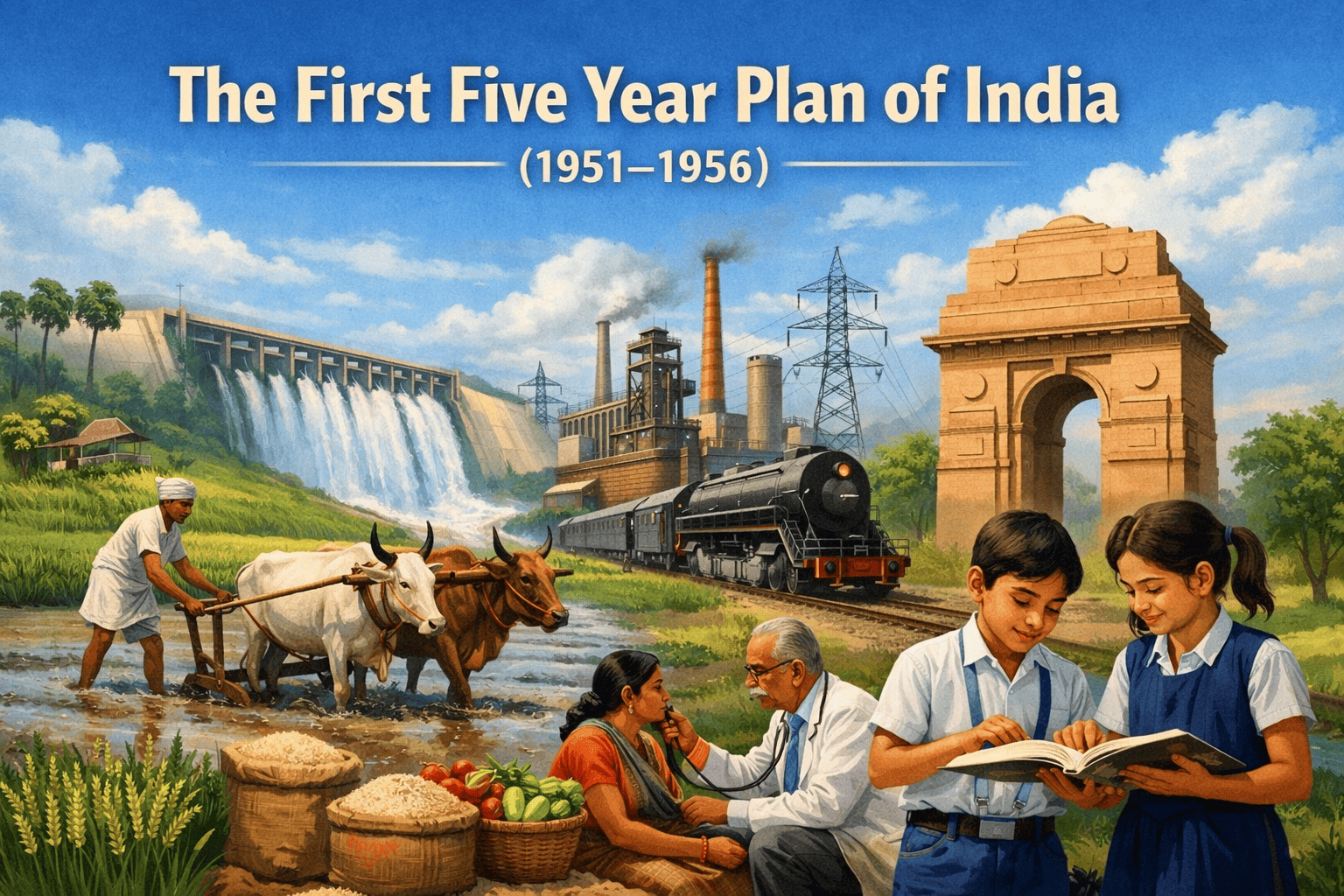
The First Five Year Plan of India (1951–1956)
Introduction
The First Five Year Plan of India was launched in 1951, just four years after India gained independence. At that time, the country was facing severe economic problems such as poverty, unemployment, food shortages, low industrial production, and poor infrastructure. The economy was mainly agricultural, and frequent famines and droughts had weakened rural life. To address these challenges and place the country on the path of planned development, the Government of India adopted economic planning. The First Five Year Plan marked the beginning of systematic and organized economic development in independent India.
Background of the First Five Year Plan
After independence, India inherited a weak and underdeveloped economy from British rule. The partition of the country had disrupted agriculture, industries, trade, and transport. Food scarcity was a major concern, and inflation was high. There was also a lack of basic facilities such as irrigation, power, roads, and healthcare.
To guide national development, the Planning Commission was established in 1950 under the chairmanship of Prime Minister Jawaharlal Nehru. The First Five Year Plan was prepared soon after and came into effect on 1 April 1951. It was largely based on the Harrod-Domar growth model, which emphasized capital investment for economic growth.
Period and Outlay
The First Five Year Plan covered the period from 1951 to 1956. The total planned outlay was about ₹2,069 crore. Most of this investment was allocated to agriculture, irrigation, power, and transport, reflecting the urgent need to stabilize the economy and ensure food security.
Objectives of the First Five Year Plan
The main objectives of the First Five Year Plan were clear and practical in nature.
The first objective was to increase agricultural production to overcome food shortages and control inflation.
The second objective was to rehabilitate refugees displaced due to partition and provide them with employment and housing.
The third objective was to develop basic infrastructure such as irrigation, power, roads, and railways to support future industrial growth.
The fourth objective was to stabilize prices and restore economic balance.
The fifth objective was to lay the foundation for long-term economic development through planned investment.
Priority to Agriculture
Agriculture was given the highest priority in the First Five Year Plan. This was because more than 70 percent of the population depended on agriculture for their livelihood, and food shortages were causing serious problems. The plan aimed to increase food grain production by improving irrigation, using better seeds, and expanding cultivated land.
Major irrigation projects such as the Bhakra Nangal Dam, Hirakud Dam, and Damodar Valley Project were started or expanded during this period. These projects helped in controlling floods, generating electricity, and providing water for agriculture.
Development of Infrastructure
The First Five Year Plan focused heavily on building basic infrastructure. Investment in power generation increased, and new power stations were established. Transport facilities, especially railways and roads, were improved to support trade and movement of goods.
Communication systems such as postal and telegraph services were also strengthened. These developments created a strong base for future industrial and economic growth.
Industrial Development
Although agriculture received the highest priority, industrial development was not ignored. The plan encouraged the growth of small-scale and cottage industries, which provided employment opportunities and supported rural development.
Some progress was also made in industries like cement, fertilizers, and textiles. However, heavy industries were not emphasized during this plan, as the immediate focus was on economic stability and food security.
Social Sector Development
The First Five Year Plan also paid attention to social development. Programs were launched to improve education, health, and housing. New schools and colleges were established, and efforts were made to expand primary education.
In the health sector, steps were taken to control diseases such as malaria, tuberculosis, and smallpox. Hospitals and primary health centers were set up in rural areas to improve public health.
Employment Generation
One of the important goals of the First Five Year Plan was to create employment opportunities. Investment in agriculture, irrigation projects, and small industries helped generate jobs, especially in rural areas. Public works programs also provided employment to a large number of people.
Achievements of the First Five Year Plan
The First Five Year Plan is generally regarded as a successful plan. Agricultural production increased significantly, especially food grains. National income grew at a rate higher than the target, and inflation was brought under control.
Major irrigation and power projects strengthened the economic base of the country. Infrastructure development improved connectivity and productivity. The plan also succeeded in restoring economic stability after the disruptions caused by partition and independence.
Limitations of the First Five Year Plan
Despite its success, the First Five Year Plan had some limitations. Industrial growth was slow, as heavy industries were not given much importance. The benefits of development were not evenly distributed, and some regions progressed faster than others.
There was also a continued dependence on good monsoons, which made agricultural growth uncertain. Moreover, population growth reduced the impact of economic gains on per capita income.
Overall Significance of the First Five Year Plan
The First Five Year Plan laid the foundation for planned economic development in India. It helped build confidence in the planning process and demonstrated that systematic government intervention could accelerate development. The success of this plan encouraged the government to adopt more ambitious strategies in the subsequent Five Year Plans.
Conclusion
The First Five-Year Plan of India was a landmark in the country’s economic history. By prioritizing agriculture, infrastructure, and economic stability, it addressed the most urgent problems faced by the newly independent nation. Although it had certain limitations, the plan played a crucial role in setting India on the path of planned and sustainable development. Its achievements continue to be remembered as the first major step in India’s journey towards economic growth and self-reliance. 0 0 0
Visit Our Website for H S 2nd Year All Solutions: Store Amar Axom
Frequently Asked Questions on the First Five Year Plan of India
Q1. What is the First Five Year Plan of India?
The First Five Year Plan of India (1951–1956) was the country’s first systematic economic development plan, aimed at addressing food shortages, unemployment, and infrastructure needs while laying the foundation for long-term growth.
Q2. When was the First Five-Year Plan of India implemented?
The First Five-Year Plan of India was implemented from 1951 to 1956.
Q3. Who prepared the First Five-Year Plan of India?
The First Five Year Plan of India was prepared by the Planning Commission, established in 1950 under the leadership of Prime Minister Jawaharlal Nehru.
Q4. What was the main focus of the First Five-Year Plan of India?
The main focus of the First Five Year Plan of India was agriculture, especially irrigation, food grain production, and rural development, to ensure food security and economic stability.
Q5. How much was the total outlay of the First Five Year Plan of India?
The total outlay of the First Five Year Plan of India was approximately ₹2,069 crore, mainly allocated to agriculture, irrigation, power, and infrastructure development.
Q6. What were the major achievements of the First Five Year Plan of India?
The major achievements of the First Five Year Plan of India include increased food grain production, improved irrigation facilities, strengthened infrastructure, employment generation, and economic stability.
Q7. What were the limitations of the First Five Year Plan of India?
The limitations of the First Five Year Plan of India include slow industrial growth, uneven regional development, dependence on monsoons, and limited per capita income growth due to population increase.
Q8. Why is the First Five Year Plan of India considered significant?
The First Five Year Plan of India is considered significant because it laid the foundation for planned economic development, stabilized the economy, and provided a framework for future Five Year Plans.
Q9. Which sector received the highest priority in the First Five Year Plan of India?
The agriculture sector received the highest priority in the First Five Year Plan of India to combat food shortages and support the majority of the population. 0 0 0